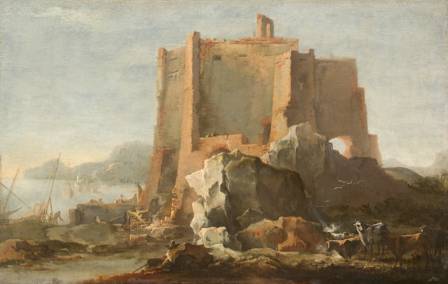
Stall note
The Allure of Ruins—Architectural Decay in Art
There is a haunting charm in crumbling architecture. Whether brought down by conflict or the slow erosion of time, these structures hint at a distant, magnificent past. Though weathered and overtaken by nature, they stand as silent witnesses to human achievement. Ruins evoke the Latin adage, sic transit gloria mundi—all worldly glory is fleeting. Many artists have sought to capture this sense of vanished splendor in their work.
Orion Black
Curator note
Stall tip
The full note continues below on the linen catalog desk.
Aisle
Stall Desk
There is a haunting charm in crumbling architecture. Whether brought down by conflict or the slow erosion of time, these structures hint at a distant, magnificent past. Though weathered and overtaken by nature, they stand as silent witnesses to human achievement. Ruins evoke the Latin adage, sic transit gloria mundi—all worldly glory is fleeting. Many artists have sought to capture this sense of vanished splendor in their work.
The representation of ruins, including capriccio—semi-imaginary architectural compositions—emerged during the Renaissance. Artists were drawn to the elegance of Classical columns and colonnades, as well as the dramatic forms of Gothic buildings. Let’s explore some remarkable works that immortalize architectural decay.
Roman Ruins by Hubert Robert, ca. 1760, Worcester Art Museum, New England, USA. Wikimedia Commons (public domain)
Hubert Robert, often called the “Robert of the Ruins,” was an 18th-century Romantic artist celebrated for landscapes and capriccios. Among his roughly 1,000 works, scenes of Italy’s and France’s ruins dominate.
In Roman Ruins, we see the remains of a once-grand colonnade, now overtaken by weeds and creeping plants. Broken wooden fences enhance the sense of abandonment. Villagers and grazing cows bring life to the otherwise desolate scene. A massive statue at the center emphasizes the monumental scale of the ruin, dwarfing the living figures and highlighting the grandeur of the past.
A Ruined Gothic Church beside a River by Moonlight by Sebastian Pether, ca. 1841, National Trust, UK. Wikimedia Commons (public domain)
Sebastian Pether, a British landscape painter of the late 18th century, faced financial hardships and personal sorrow, yet his works possess a poetic, theatrical quality.
This nocturnal painting depicts a ruined Gothic church illuminated by moonlight, its intricate architecture partially hidden by climbing vines. A wide, reflective river stretches through the scene, leading the eye to distant mountains and vague constructions. Pether’s meticulous attention to detail creates depth and a quietly dramatic, melancholic atmosphere.
Capriccio of Classical Ruins by Giovanni Paolo Panini, ca. 1725–1730, private collection. Wikimedia Commons (public domain)
Giovanni Paolo Panini, a Roman painter and architect, directed a notable workshop that included his son Francesco and Hubert Robert. Renowned for his views of Rome, Panini used his architectural expertise to render ruins with precision.
In Capriccio of Classical Ruins, broken sections of buildings lie scattered, some partially submerged in water. Vegetation takes root in the crevices, emphasizing decay. Human figures appear small against the immense structures, reinforcing the overwhelming scale of these remnants of antiquity.
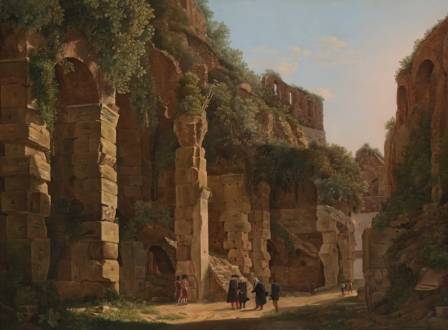
Ruins in Baalbek by Jules Louis Coignet, ca. 1846, Musée des Augustins, Toulouse, France. Wikimedia Commons (public domain)
Jules Louis Coignet, a French landscape painter, exhibited widely in Paris and blended Idealist and Realist tendencies. During his travels, he painted the Roman ruins of Baalbek in Lebanon, once known as Heliopolis, home to massive temples dedicated to Bacchus and Jupiter.
Classical forms dominate the composition, yet local architectural styles influence the layout. A large tree anchors the foreground, partially obscuring crumbling structures. Figures in traditional attire, including a rider on horseback, populate the scene, linking past grandeur with contemporary life.
Landscape with Classical Ruins and Figures by Marco Ricci and Sebastiano Ricci, ca. 1725–1730, J. Paul Getty Museum, Los Angeles, USA. Wikimedia Commons (public domain)
This collaborative painting by uncle Sebastiano Ricci and nephew Marco Ricci shows life unfolding amidst decaying Roman monuments.
Groups of people interact obliviously with each other and the ruins around them. A reclining statue dominates the foreground, establishing a relaxed and contemplative tone while contrasting the grandeur of the surrounding architecture.
Ruins of the Palace by Ramon Martí Alsina, ca. 1859, Museu Nacional d’Art de Catalunya, Barcelona, Spain. Wikimedia Commons (public domain)
Ramon Martí Alsina, a Spanish Realist painter, created this striking depiction of a grand Catalan palace in ruins beneath a brooding sky. Figures animate the scene, adding tension and narrative. The hollow remains suggest wind moving through the structure, enhancing the painting’s melancholy and emotional depth.
Gothic Church Ruin by Carl Blechen, ca. 1829–1831, private collection. Wikimedia Commons (public domain)
Carl Blechen, a 19th-century German landscape artist and professor, captures a Gothic church being slowly overtaken by wild vegetation. Watercolors give the scene luminous clarity. The intact stained-glass windows hint at calm daylight, while the ruins themselves suggest a mysterious, almost spectral presence by night.
Ruins of Rosemont Castle by Johan Jongkind, ca. 1861, private collection. Wikimedia Commons (public domain)
Dutch Impressionist Johan Barthold Jongkind focuses here on the Château de Rosemont in France. The low horizon emphasizes sky and light, while scattered figures and cattle animate the landscape. The painting evokes tranquility alongside historical decay, blending genre and landscape traditions.
The Ruins of Holyrood Chapel by Louis Daguerre, ca. 1824, Walker Art Gallery, Liverpool, UK. Wikimedia Commons (public domain)
Louis Daguerre, a French artist and inventor of the daguerreotype, trained as an architect and stage designer. He portrays Holyrood Abbey in Edinburgh under moonlight, its romantic ruins exquisitely detailed despite darkness. The nocturnal setting enhances mystery and theatricality, blending architectural precision with atmosphere.
Christ and the Adulteress by Ascanio Luciano, ca. 1669, private collection. Wikimedia Commons (public domain)
Italian painter Ascanio Luciano, specialized in architectural capriccios. In this work, the story of Christ and the Adulteress unfolds amidst classical ruins. The composition dramatizes the Biblical episode, highlighting the contrast between human action and the imposing, silent backdrop of decayed architecture.
The Ruins of the Temple of the Sun, Palmyra by Carl Haag, ca. 1859, private collection. Sothebys
German artist Carl Haag traveled extensively and befriended local leaders in Syria. Inspired by Palmyra, he painted its classical ruins in delicate watercolors. Figures, camels, and animal skeletons populate the desert landscape, while Corinthian columns catch the setting sun, evoking the glory and power of the ancient city of Queen Zenobia.
More from this aisle
CRAFT · en
Famous Night Paintings and Why They Work
Let’s explore some of my favorite nocturnal paintings and why they resonate. At the end, I’ll share a few practical tips for painting night scenes.
CRAFT · en

Facts About Koalas
Want to discover more about one of Australia’s most adorable animals? Let’s explore some interesting facts about koalas and learn what makes these furry creatures so unique.
CRAFT · en

8 Clever Ways to Use Up Leftover Lemon Juice
After zesting lemons for a homemade limoncello experiment, I found myself with over a cup of fresh lemon juice and no peel left to use. Instead of letting it go to waste, I looked for creative ways to put it to good use. Whether you have a full cup or just a few tablespoons, these smart ideas will help you make the most of every drop.
CRAFT · en

The deep sea coral reefs
When people hear the words “coral reefs,” they often imagine colourful underwater landscapes located just beyond the shoreline, where snorkelers and divers explore vibrant marine habitats.
CRAFT · en

Colorful Wonders: 9 Intriguing Crayon Facts You Might Not Know
While the exact origin of the modern crayon remains a mystery, the artistic tradition of blending pigments with oils stretches back millennia. This ancient technique, utilized by numerous cultures, laid the groundwork for the drawing tools we recognize today.
CRAFT · en

Essential Kitchen Tools Used by American Pioneers
Long before stand mixers became countertop staples, air fryers competed for cabinet space, and electricity became a normal part of everyday life, pioneer kitchens operated with remarkably few conveniences. In these early American homesteads, meals were prepared without modern appliances such as Cuisinart or KitchenAid machines. Instead, families depended on their hands, a small collection of basic utensils, physical effort, and plenty of practical creativity.