Basic information & taxonomy

Stall note

Basic information & taxonomy

Common names: Western rockhopper penguin (sometimes also lumped with “southern rockhopper penguin”) Scientific name: Eudyptes chrysocome (Forster, 1781)

N

Noah Davis

Curator note

Stall tip

The full note continues below on the linen catalog desk.

Aisle

Stall Desk

Common names: Western rockhopper penguin (sometimes also lumped with “southern rockhopper penguin”)
Scientific name: Eudyptes chrysocome (Forster, 1781)
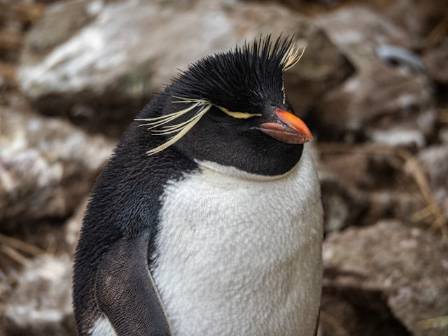
It is one of the “crested penguins,” characterized by prominent yellow crest feathers above the eyes.
There has been debate among taxonomists about how many distinct species or subspecies of rockhopper penguins there are. Some treat the Western form as distinct from the Eastern and Northern rockhoppers; others treat them all as subspecies of Eudyptes chrysocome.
  Within that framework, E. c. chrysocome is the “western” subspecies (i.e. the form breeding off South America) and E. c. filholi is the “eastern” or Indopacific subspecies.
  The northern rockhopper penguin, Eudyptes moseleyi, is genetically distinct and often treated as a separate species.

Description & size

Among the Eudyptes (crested) penguins, this is the smallest yellow-crested black-and-white penguin.
Size: ~ 45 to 58 cm in length (~18 to 23 inches)
Weight: generally 2.0 to 3.4 kg (4.4 to 7.5 lb), though some exceptional individuals weigh up to ~4.5 kg (≈9.9 lb)
Upper parts: slate-gray or dark; head, face and back dark; underparts white with sharp demarcation at throat.
Crest: The yellow “eyebrow” stripe starts about 1–2 cm above the gape, broadening into a wedge in front of the eye, and behind the eyes the crest feathers droop sideways.
Bill & eyes: The bill is orange-red. The eyes are red. The skin at the base of the bill is black (i.e. there’s no pale or fleshy skin there, which helps distinguish it from some related forms).
Legs & feet: Pink with black soles.
Immature birds: somewhat smaller, with greyer throat and less well developed crests.

Ecology, behaviour & diet

Habitat & distribution: Breeds in subantarctic islands off southern South America (e.g. Falkland Islands, islands off Patagonia). The “western” form’s stronghold is around the Falkland Islands.
Outside breeding season: individuals disperse widely into surrounding ocean waters.
Diet: Primarily crustaceans (krill, etc.), but also squid, octopus, small fish (lantern fish), mollusks, and cuttlefish.
Foraging & dives:   • They use both pelagic dives (shallower, in open water) and benthic dives (near the seafloor).   • Benthic dives can reach up to ~100 m (≈ 330 ft) depth.   • Dive duration: typical aerobic dives are limited to ~110 seconds; some dives may last up to ~180–190 seconds (i.e. pushing physiological limits)   • Females generally forage during the day, making multiple dives in trips lasting many hours. Occasionally they might forage at night, but nighttime dives tend to be shallower.   • They may range far: foraging trips up to ~157 km (≈ 98 miles) from the colony have been documented.
Locomotion on land: Unlike many penguins that slide (toboggan) on their bellies, rockhoppers “hop” over rocks and boulders, hence their common name.
Breeding & reproduction:   • They breed in colonies on cliffs, rocky shores, sometimes inland or up cliffs.   • Breeding season: September to November (in the Southern Hemisphere)   • Clutch size: usually two eggs are laid, but typically only one chick is successfully reared (the first egg often fails).   • Incubation: ~ 35 days   • After hatching: chicks are brooded for ~26 days before being left more independently.
Longevity: One known individual (“Rocky”) in captivity lived to ~ 29 years and 4 months (in a Norwegian aquarium).

Conservation status & threats

The global population is estimated at around 1 million pairs (i.e. ~2 million adult birds) for the rockhopper complex, with a large share belonging to the E. c. chrysocome (western) population.
Population trend: The western rockhopper (and rockhoppers generally) has experienced substantial declines — about a one-third drop over the last ~30 years (as of the time of the article)
Threats:   • Commercial fishing (competition for prey, bycatch)   • Oil spills and pollution in ocean waters
Status: Classified as Vulnerable by the IUCN.
Human interactions:   • Historically, indigenous peoples (e.g. the Yahgan people in Tierra del Fuego) hunted them for food.   • Today, their colonies attract ecotourism, which can have both benefits (awareness, protection) and risks (disturbance)   • In captivity / zoological settings: European zoos coordinate breeding programs; Drusillas Park in East Sussex holds the studbook for rockhopper penguins in Europe.

More from this aisle

CR

CRAFT · en

Understanding the Unique Traits of the Roadrunner

Understanding the Unique Traits of the Roadrunner

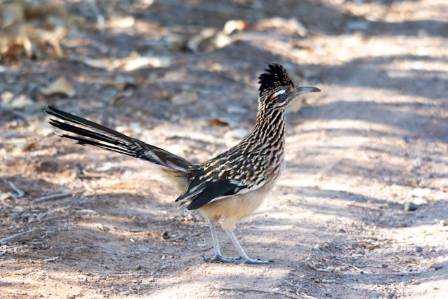
Commonly recognized from their legendary appearances in animation, actual roadrunners are far more complex and intriguing than their cartoon counterparts. These birds belong to the cuckoo family, and while they differ significantly from their relatives in appearance, their vocalizations often consist of a distinct "coo" sound. As primarily ground-dwelling birds, they have evolved a lifestyle centered on speed and agility rather than flight.

CR

CRAFT · en

The World's Newest Architectural Marvels: Your Guide to Top Projects

The World's Newest Architectural Marvels: Your Guide to Top Projects

Today we invite you to embark on this exciting voyage and explore the groundbreaking architectural wonders. Believe us, it will be an exciting journey through different countries of the world! We will visit the United Arab Emirates, the USA, mysterious Australia and China.

CR

CRAFT · en

Top 6 Universities with Accomplished and Stunning Female Students

Top 6 Universities with Accomplished and Stunning Female Students

Are you searching for universities with accomplished and stunning female students? Look no further, as several institutions in the USA boast not only attractive but also intelligent, ambitious, and driven women. Explore the top 6 universities where young women showcase their talents in sports, leadership, and various fields.

CR

CRAFT · en

Maho Beach: A Comprehensive Guide to the Ultimate Plane-Watching Paradise

Maho Beach: A Comprehensive Guide to the Ultimate Plane-Watching Paradise

Nestled in the Dutch Caribbean, Maho Beach stands as an awe-inspiring destination, catering to aviation enthusiasts seeking an extraordinary experience. This beach, renowned for its captivating low-flying airliners, resides just beyond the Princess Juliana International Airport's runway, offering an unparalleled vantage point for witnessing planes take off and touch down. To ensure visitors don't miss a moment of the spectacle, daily airline timetables adorn most bars and restaurants along the beach.

CR

CRAFT · en

French Cheese Plate Ideas

French Cheese Plate Ideas

Briton Matthew Feroze, winner of the 2013 Concours National des Fromagers at the prestigious Salon Mondiale de Restauration et Hôtellerie, shares his award-winning cheese board selection. He breaks down the exact cheeses used in his celebrated platter, offering both tasting notes and expert guidance on how to build the ultimate French-style cheeseboard—an unmatched masterclass in cheese presentation.

CR

CRAFT · en

Top 10 Most Beautiful Women in the World, Ranked by Science

Top 10 Most Beautiful Women in the World, Ranked by Science

Naming the most beautiful woman on Earth might sound subjective — after all, beauty lies in the eye of the beholder. Still, modern science has developed ways to analyze physical attractiveness using mathematical principles that offer some objective perspective. Dr. Meegan Gruber, a Florida-based board-certified plastic surgeon, explains that while beauty standards shift with culture and time, certain universal traits consistently appeal to human perception. “The way we define beauty is influenced by both societal norms and individual preferences,” she says. “But mathematics, like the Golden Ratio, has long been used to assess symmetry and proportion — key aspects of perceived beauty.”